Showing posts with label Jean Baudrillard. Show all posts

Sunday, October 17, 2010

What You Wear: Mystique, Clothing, and Sexuality


Mystique in original costume
- X-Factor #108 (1994)
A short post to keep things going, this time on how the Marvel Comics villain, Mystique has been portrayed sexually through her clothing throughout her thirty year plus career. 

Kaja Silverman in her essay 'Fragments of a Fashionable Discourse' writes that clothing and dress is an important cultural implement for affixing sexual identity (1986:146), and Mystique’s clothes/costumes support this theory. As a representation of her sexuality, Mystique’s clothes change throughout her career identifying to the reader what to expect (or not) from her sexually. Her first costume in which she was seen from approximately 1977 to 1995, covers her breasts and upper torso tightly, while her groin is covered by a long flowing skirt that is side split to the waist that would hardly hide her genitalia in any situation, and emphasises her breasts as fetish objects.


Mystique as coloured nude
- X-Factor #127 (1996)
As a villain she holds the attributes of the phallic woman (not the least because she can transform into a male) represented by the fact that at any moment her skirt may reveal an actual phallus, which is no doubt an entertaining but horrifying possibility for her heroic foes (and fans). The skulls on her belt are also indicative of the possible horror lurking beneath. At this stage of her career we don't know where her sexual preferences lie. She is sexually ambiguous. Hinted at for many years but finally revealed in X-Men Forever #5 (2001, on the inside front cover), is that Mystique's constant companion, the precognitive mutant, Destiny (aka Irene Adler), is her lover. Therefore she threatens patriarchal culture in the X-Men titles not just as a phallic woman but also although not explicitly stated) as a lesbian.

As a member of the X-Factor team (X-Factor, 1995 to 2003), and therefore coded good, her clothes/costume changes from exhibiting threatening polyphallic qualities to a more feminised, appealing figure. Like many other female heroes, and like much superhero comic art, Mystique is drawn as a coloured nude, expressing a closed, smooth body, that is sexually appealing to males. She becomes, as Jean Baudrillard argues, a phallic effigy, a safe reflection of the masculine rather than an opposition. 
Mystique in leather 
costume-
Mystique #4 (2003)

When Mystique gets her own series (2003-05) her costume consists of a cropped black leather top, pants, gloves, and heavy black boots. Leather is associated with toughness and masculinity as well as erotic connotations suggestive of danger, seduction, and sado-masochism. As Sherrie Inness suggests, wearing masculine clothing is indicative of a woman’s ‘capacity for action and leadership’ (1999:25). Thus leather marks Mystique as active rather than the passivity associated with the feminine. Keeping these associations in mind, leather is implicitly linked to lesbianism, and as such indicate Mystique’s alignment with lesbianism. While she isn't associated with any female lovers (or male for that matter) in the Mystique series, Brian Vaughn (writer) makes quite clear her preference for females by a number of intertextual "queer" references. In Mystique #7, a man in an airport walks past an attractive woman, muttering, ‘Have mercy’ (Vaughn and Ryan, 2003:19). The man happens to be Mystique in a male form. In Mystique #19 she is presented with a pen once used by Oscar Wilde.
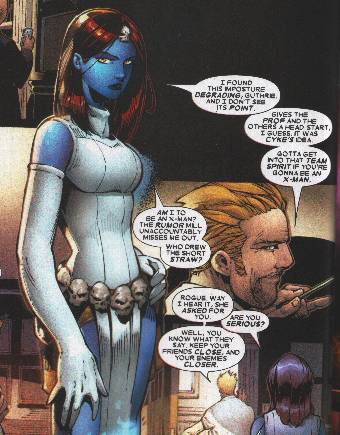

Mystique in costume 
similar to her original -
 X-Men #189 (2006)
Mystique keeps her leathered-up look throughout X-Men #172-187, her appearance in X-Men (August 2005) coming after the Mystique series was discontinued (April 2005). In this run of issues Mystique's queerness is still evident albeit twisted. I won't go into the logicalities (or illogicalities) of her strategy, but suffice to say that in X-Men #172 Mystique begins a series of episodes where she tries to seduce Rogue’s boyfriend, Gambit, in an effort to help Gambit and Rogue’s relationship. But she is clearly operating at odds with herself as she remarks to Gambit of having sex with him: ‘The idea repels me as much as it does you’ (Milligan et al, 2005:31). Her sexual preference then is still clearly for women.

In X-Men #189 (2006) she returns to a costume very similar to her original and - apart from a short regress to a costume reminiscent of her X-Factor outfit (with skulls removed) - has remained with it up to the present (October 2010). Though operating in the X-Men and Dark X-Men teams, she is once again clearly a villain. This period is characterised for Mystique by a storyline running through the X-Men titles (the 'Messiah Complex' crossover) involving Destiny and her diaries. Thus what is happening is that her sexuality is subsumed, being made covert as represented by choice of costume.

While there is a storyline where Mystique has a love/hate relationship with Iceman (X-Men and X-Men: Manifest Destiny, 2008-09)  Mystique's actions with Iceman are characterised by the following exchange - 
Iceman:'I let you get close to me once. Touch me. I wish to God I hadn't!' 
Mystique: 'So do I. It's hard to pretend that touch didn't happen. But I'm working on it.' (Carey and Ryan 2009a:5).
Dark X-Men #4 
(2010)
However Mystique's words are ambiguous. They can be attributed either to her not liking Iceman, or her not liking men in general. Of course, it could be both.

In X-Men: Manifest Destiny #5, after a terse exchange where Iceman rejects Mystique's misguided overtures (if they are that), Mystique says, 'You'll love me. I promise you that.' (Carey and Ryan 2009b:7). Again, what it actually means is anybody's guess. To the present there has been no indication of further interest in Iceman by Mystique.

In Dark X-Men #4 (2010) Mystique mentions Irene (Destiny) in trying to make sense of her situation involving Norman Osborn. These references and her costume signal a return to her ambiguous sexual nature - neither explicitly straight or gay. Mystique's relationship with Destiny has always been subtle and unlike characters such as Northstar who famously came out of the closet to reveal his gay sexuality, the same 'coming out' hasn't been afforded Mystique. Neither has she been explicitly positioned as bisexual. Is this a problem? Not necessarily. In fact Mystique's constant changes make her one of the most interesting comic characters in any comic universe. Whether she's gay, bisexual, or straight, doesn't particularly matter unless there's a problem with Mystique being portrayed as such. The question then is - why would that be? If she's bisexual or lesbian, why not make it clear?

For now it seems Mystique is once again an unknown sexual quantity.


Dark X-Men #3 
Cover (2010)
Reference


Carey, M. (w), Ryan, M. (p), and Olazaba, V. (i) (2009a) 'Kill or Cure, Part 4', in X-Men: Manifest Destiny #4 ( Lowe, N. Ed.)(Feb. 2009), New York: Marvel Publishing Inc.


Carey, M. (w), Ryan, M. (p), and Olazaba, V. (i) (2009b) 'Kill or Cure, Part 5',in X-Men: Manifest Destiny #5 ( Lowe, N. Ed.)(March. 2009), New York: Marvel Publishing Inc.


Inness, Sherrie. (1999) Tough Girls: Women Warriors and Wonder Women in Popular Culture, Philadelphia: University of Pennsylvania Press.


Milligan, P. (w), Larroca, S. (p), and Miki, D. & Martinez, A. (i) (2005a) ‘Bizarre Love Triangle: Temptation: Part 2 of 4',  X-Men v1 #172 (Aug. 2005), New York: Marvel Comics.

Silverman, Kaja. (1986) ‘Fragments of a Fashionable Discourse’, in Modleski, T. (ed.) Studies in Entertainment: Critical Approaches to Mass Culture, Bloomington: Indiana University Press.


Vaughn, B. (w), and Ryan, M. (p)(2003)‘Tinker, Tailor, Mutant, Spy, Chapter One of Four’, Mystique v1 #7(Dec. 2003),New York: Marvel Comics.

The BookDepository

Friday, June 25, 2010

Notice the Difference? Eliminating the Feminine in Superhero Comics

In the coming posts I will be going retro and presenting pieces on comics produced in the 1990s, specifically the comics Wetworks, Darkchylde, and Witchblade,

In this three part essay I discuss how the feminine is effectively eliminated in superhero comics by eradicating the difference between the sexes reducing them to an economy of the same.

Part 1 compares standard human anatomy with bodies in superhero comics showing how female characters are depicted with characteristics of the ‘standard’ male body. Male bodies are subsequently rendered as hypermasculine. Using the work of Jean Baudrillard I show how the female superhero body is phallicised thus creating ‘erectile’ parts.

Part 2 uses Baudrillardian theory to analyse the superhero comic Wetworks demonstrating how the phallicised female body is eliminated when it is used as a mirror that reflects male dominance and desire. The female is further not allowed to become a body due to her potential threat of castration (the vagina dentata and the phallic woman) which is eliminated when she is eliminated as female.

Part 3 covers how armouring the male superhero body is an attempt to elicit self-control and thereby control the feminine that is embodied in chaotic, uncontrollable and changing ‘outside forces’. I further establish how armouring the body is unworkable due to its passive mode of resistance. I describe the next step in the process to control outside forces as becoming the weapon/machine and the consequences that this can have for culture at large.


Notice the Difference? Eliminating the Feminine in Superhero Comics
(Part 1)

Of course the female form has absurdly exaggerated sexual characteristics; of course the costumes are skimpier than one could (or should) imagine; of course there’s no visible way that these costumes could stay in place; of course these women represent simple adolescent masturbatory fantasies (with a healthy taste of the dominatrix) (Bukatman 112).

The female superhero body is constructed as hyperfeminine, as a spectacle insistent on breasts, thighs, crotch, and hair. In the quote above Scott Bukatman answers why female superheroes are drawn the way they are – they’re eye candy to satisfy the male gaze. You might also answer that because the vast majority of superhero comic artists are male, they draw female superheroes that way because they can. But what is it about these female superhero bodies that make them so good to look at so that, of course, they must be drawn with absurdly exaggerated sexual characteristics? Why are their costumes skimpier than one ‘should’ imagine? There must be more to it, and there is.

In part one of this essay I’ll undertake an anatomical comparison of ‘real’ female bodies against bodies represented in superhero comics. This line of reasoning will explicate how the female superhero body is depicted according to characteristics normally associated with the male body. The male body, in turn, has been exaggerated to hypermasculine proportions. I’ll argue that superhero comics reduce all ‘others’ to the economy of the same by eradicating the difference between the sexes (Irigaray 74). I’ll use the work of the French theorist Jean Baudrillard to demonstrate how the male and female superhero bodies and body parts are phallicised as ‘erectile parts’.

In her book An Introduction to Drawing the Nude Diana Constance recognises that the standard female torso is longer than a male’s, the distance from her waist to crotch is also longer, and her hips are wider than her shoulders – ‘no amount of dieting will ever give her the slim hips of a man’ (Constance 23-4). The ‘standard’ body of a male has longer legs than a woman and his shoulders are slightly wider than his hips (Constance 23). Comparing the ‘standard’ body of a human to that of a comic book character might seem silly or even absurd but there is nothing to say that characters shouldn’t, at least proportionally, exhibit the characteristics of a ‘standard’ body. However, in superhero comics there is a radical inversion of the female’s standard body characteristics where the female superhero body exhibits characteristics of the standard male body. Their shoulders are wider than their hips and their legs are longer than a males (sometimes alarmingly so). Because of this fusion of the female into the male form, the distinctive sexual characteristic of the female – her breasts – are made prominent to distinguish the character’s “femininity”. This in turn makes the breasts appear unrealistic, ‘stuck’ on, and disharmonious with the rest of the body. The effect this has on the depiction of the male superhero body is that male features need to be exaggerated to a hypermasculinity. The male’s shoulders and legs are made wider (by muscles or armour/costume), and the torso becomes overtly muscled and lengthened.


There is further evidence to suggest that female and male superhero bodies are ascribe to the one ideal. The ‘standard’ female body requires the pubic area to be just below the mid-point of the body (Constance 23). Moving the pubic area above a females’ natural mid-point, lengthens the legs and shortens the torso thereby eliminating the hips (a defining female body feature), leaving the legs to butt straight on to the waist. With the torso shortened the female gains another ‘standard’ male body feature. This elimination of the female characteristics is demonstrated in the WILDC.A.T.S advertisement (Figures 1 and 2) where the male and the female characters, Ripclaw and Zealot, have virtually the same body (high heels and hair too)! (See further images in the Image Appendix). The elimination of the female body, I believe, has to do with the fetishisation/phallicisation of the female form. The work of theorist Jean Baudrillard provides a useful framework for understanding this phenomenon.

Superman’s value as the first ‘super’ hero was of a symbolic nature. All the drive he needed was the inherent goodness in doing the job. No rewards necessary or wanted. The ‘S’ on his chest is his sign; his symbol of recognition. Without the ‘S’ he’s just a big guy in a blue suit. The costumes of more contemporary superheroes are conspicuously devoid of individual signs, (characters from the Image titles of the early 1990s are a case in point). They are just big guys in colourful suits. Far from being superheroes for the sake of it, many are employed by an individual, corporation, or governmental department, consequently embedding them in the political economy of the sign. By accepting money for their heroic actions they become rationalised subjects, turning them into items of exchange value – the abstract, meaningless value of quantity measured in monetary terms. A superhero’s exchange value can subsequently only be measured against that of other superheroes.

Without individual signs that designate identity (or only ones that align them with a certain group or corporation) the superhero is now merely a sign that reproduces the capitalistic economy. Now to designate a superhero’s individuality the superhero’s body becomes a sign – the guy in this suit is bigger and different that the guy in that colourful suit. However, Baudrillard states that signs covering the body reduce it to uniformity or an ideal type. Signs cover, divide and annihilate the body’s difference in order to organise it into structural material for sign-exchange (101). Thus the superhero’s body can also be reduced to an ideal type. This ideal is derived from one source – a body and an economy derived from ‘a sexuality taken as a determining agency, a phallic agency entirely organised around the fetishisation of the phallus as the general equivalent’ (Baudrillard 101). The hypermasculine male ideal of which the superhero stands as an emblem is designed around this phallic general equivalent. As Scott Bukatman argues –

Indeed, with their thick necks, bulging veins, and protruding tendons tightly swathed in coloured skintight hoods, these heroes really become enormous dicks sheathed in an array of distinctly baroque (and somewhat painful looking) condoms – an effect both menacing and comical (111).

In Baudrillard’s terms – ‘the entire body has become a phallic effigy’(102). For Baudrillard the body has moved into representation, it is a sign that is constructed via a structuralist mode consisting of the phallic effigy/fragment of the body/subject as signifier, and sexuality as signified. The body is not an erogenous zone anymore, but an eroticised zone in a capitalist economy of exchange value. It is a site that does not produce excitement but is produced to excite.

We must remember that for the most part superheroes – ‘Despite accoutrements such as logos, masks, gauntlets, epaulets and other superhero accessories… are essentially presented as nudes (costumes are more coloration than cover up)’ (Bukatman 106). This colouration/costuming of superhero nudity produces ‘Certain marks… (that) render the body more nude than if it were really nude… these marks may be clothes or accessories’ (Baudrillard 121n). Accessories such as ‘the tight fitting bracelet round the arm or the ankle, the belt, the necklace and the ring’ are staple parts of superhero attire which for Baudrillard ‘establish the foot, the waist, the neck or the finger as erectile parts’ (102). While both male and female superheroes sport these accessories, the female superhero body, with exaggerated legs and breasts, is the most prominent in this process of phallusisation. While we have already seen that male superheroes are bulging ‘dicks’. However it is not only certain bodies or body parts that can be transformed into phallic effigies. In fact –
Any body or part of the body can operate functionally in the same way, provided that it is subject to the same erotic discipline: it is necessary and sufficient that it be as closed and as smooth as possible, faultless, without orifice and “lacking” nothing, every erogenous difference being conjured up by the structural bar that will design(ate) this body (in the doubles sense of “designate” and “design”), visible in clothing, jewellery or make-up, invisible but always present in complete nudity, since it then envelops the body like a second skin (Baudrillard 104-5).
Baudrillard is arguing that anything that marks the body as ‘closed and smooth as possible’ (including make-up, lipstick, tattooing, scarring) can be placed in the structural demarcation of phallic effigy as signifier, alongside male sexuality, or phallic agency, the general equivalent everything is defined against. In other words the phallus is the standard marker or measure of identity.

Reference

Baudrillard, Jean. Symbolic Exchange and Death. London: Sage, 1993.

Bukatman, Scott. “X-Bodies (the torment of the mutant superhero).” Uncontrollable Bodies: Testimonies of Identity and Culture. Ed. Rodney Sappington and Tyler Stallings. Seattle: Bay Press, 1994.

Constance, Diana. An Introduction to Drawing the Nude. London: New Burlington Books, 1993.

Irigaray, Luce. This Sex Which Is Not One. Ithaca, New York: Cornell University Press, 1985.