Showing posts with label feminist studies. Show all posts

Saturday, January 15, 2011

How I Should Feel – Fetishism and Feminine Power in Witchblade

What it says -
the Witchblade
Psychoanalytically fetishism is the substitution of an object (or objects) for the penis that the mother is found to be lacking, thereby allaying the young boy’s shock of this realisation. Jean Baudrillard theorises that the fetishised female body is produced as a phallic body, a phallic effigy (substituting the body or body parts of the female for the penis) that reflects a male narcissistic desire to revel in what he knows to be true – that he is possessor of the phallus, of power. Baudrillard theorises that the body has become a representation, a sign that is constructed via a structuralist mode that posits the phallic effigy/body fragment as signifier and sexuality as signified. In this system, the phallus becomes the general equivalent against which everything is defined –‘everything is resolved into a phallic equivalent, even the female genitals, or any gaping organ or object traditionally listed as a symbol of the feminine’ (Baudrillard 102). This theory leaves little room for female bodies to have any other meaning than phallic, however Sara in Witchblade and her union with the Witchblade itself, I believe actually subverts this phallic model and phallocentric ideology by forming a positive, distinctive model of feminine power that does not rely on a concept of the masculine to define itself.

Witchblade (Vol. 1 #1-8, 1998) is the story of New York detective Sara Pezzini, who through fateful coincidence becomes the wielder of the Witchblade. Ken resolves to befriend Sara and then erode her confidence and spirit so she will transfer the Witchblade’s power to him. The Witchblade is a sentient symbiote that bonds to the wearer’s body, mind, and soul. Its primary form is a gauntlet, but can reduce in size to a bracelet or expand to armour the body in a spiky exoskeleton. At times it has an organic, plant-like appearance. When ‘activated’ by the wielder (or of its own accord) the Witchblade can create deadly whip-like tendrils, and fire blasts of energy. The Witchblade is a source of feminine power because it can only ever be wielded by a woman. Anyone who tries to don the Witchblade, but is not the rightful recipient, receives terrible injuries from the Witchblade itself. Sara is pursued by Ken Irons, a wealthy businessman who has researched the history of the Witchblade and wants its power for himself.

Ken Irons as a totality
(and looking quite grumpy)
Witchblade’s opening pages provide a stark contrast between representations of men and women. Ken Irons is shown from a distance in his high-rise apartment, then in a medium shot (head to knees), and finally in a close-up of his face. This sequence of images presents him as a totality, a "whole" person. Our introduction to Sara is quite different. Sara is shown dressing–putting on lipstick, a tight, short dress that fixes around her neck, knee high stiletto boots, elbow length gloves, and G-string underwear with the accompanying display of buttocks, legs, breast, arms, and lips. This attire makes Sara’s body parts closed and smooth, a pre-requisite in Baudrillardian theory for them to be produced as phallic effigies (1993:104). In contrast to Ken, who is shown as a totality, Sara is presented as dismembered, a “cut-up” of highly sexualised body parts exhibiting all the attire – ‘Ankle boots and thigh boots… over the elbow gloves and stocking top on the thigh, hair over the eyes or the stripper’s G-string’ (1993:101) –which Baudrillard cites in Symbolic Exchange and Death that demarcate the body, establishing the foot, leg, arm, neck, and waist as erectile parts. This imagery is what Naomi Wolf describes as the pornography of beauty where the most sexually central parts of women, breasts, thighs, buttocks, bellies are fetishised (Wolf 1990:119). As many comic readers would agree, depictions of females in comics often employ imagery that borders on the pornographic.

Sara as dismembered body parts
Sara thus begins Witchblade embedded in the Symbolic Order, conforming to a stereotypical image of a woman in order to achieve results in her job. The Symbolic Order (or simply the Symbolic) designates the ‘objective order of language, law, morality, religion, and all social existence which is held to constitute the identity of any human subject who enters it’ (Baldick 327). It is in opposition to the Imaginary. In Lacanian psychoanalysis the pre-Oedipal (as Freud describes it) or Imaginary phase of development consists basically of two terms: the child and the image of the other, which is usually the mother (Eagleton 165). Elisabeth Grosz states that as the child develops, this dyadic structure is disrupted by the father who represents ‘law, order and authority for the child’ (1990 68). The father is a ‘Symbolic or imaginary father’, a representative of the Name-of-the-Father that stands for patriarchal ownership. Taking on the Name-of-the-Father positions the child beyond the structure of dual imaginary relations (Grosz 1990 47). Recognition of this ‘paternal metaphor’ charts the child’s entry into the Symbolic Order and the social world beyond the family structure (Grosz 1990 104). Therefore, the Name-of-the-Father signifies the ‘Law’ or Law-of-the-Father that is the wider set of social and sexual roles rules upon which the Symbolic Order rests and relies. What this means for Sara is that she has taken on the wider set of social and sexual roles that are designated “female”. This is how Sara (and indeed women in general) is “forced” to conform to a feminine ideal. Indeed as a police officer Sara enforces the law and is also an agent of the Law-of-the-Father. From an early age Sara conditioned herself to be an agent of the Law knowing that she wanted to be a cop and imitating the male cops on the 1970s television show, Starsky & Hutch. Thus she has for along identified with male roles and ideals.

However the clothes Sara is wearing are for an undercover police operation in order to right an injustice perpetrated in an earlier case. She comments ‘Starsky never had to do this to make a bust’ (Wohl et at 1998:5). Later, after being told she is ‘dressed like a slut’ she retorts, ‘Hey! You think I like wearing this?’ (Wohl et al 1998:10). That Sara doesn’t actually like wearing this apparel is an indication that something is “wrong” (because don’t all women like dressing this way?). It is a semi-conscious realisation of her knowing she is conforming to a male ideal of a woman and that she’d rather resist than accept this ideal.

The first time Sara wears the Witchblade, when it crawls and attaches itself to her and in the process saves her life, she unleashes the Witchblade’s power and suddenly feels ecstatic: I am power. This is freedom. I am... insane!’ (Wohl et al 1998:22-3). In accessing the Witchblade’s purely feminine power Sara becomes free from the Symbolic Order, yet this freedom seemingly comes (at least for a moment) at the cost of her sanity. The insane feeling is her experiencing a new paradigm of real power, one that grants her control, which is so overwhelming it feels like insanity. Later when she tries to take the Witchblade off it resists, cognisant of Sara opting to, and trying to stop her, returning to her “safe” and “sane” position in the Symbolic Order. All indications point to the Witchblade trying to wrench Sara from the Name-of-the-Father.

The second time Sara dons the Witchblade she has similar feelings of freedom, feeling ‘Unbound... she should be afraid, now she’s never been more confident’ (Wohl et al 1998: 66). This time she chooses to accept the feeling, the insanity – ‘That was the trouble while she was fighting it. But now... she’s strangely at peace with it. Connected to it’ (Wohl et al 1998: 67). The Witchblade’s power brings Sara peace, becoming more comfortable with feminine power free from patriarchal constraints. The Witchblade facilitates her realising what she already seems to unconsciously recognise–which is why the Witchblade chooses her.

Sara covered by the organic-looking Witchblade
while she sleeps
Sara takes the Witchblade off to sleep but while sleeping it sentiently reattaches to her body and covers her completely. In the morning in a full page illustration she lies asleep in a foetal position which is at once an image of rebirth and a voyeuristic tour de force, she recounts ‘I felt it on me, like some protective shell... it felt right on me. And I didn’t want to wake up because it felt so good... so safe’ (Wohl et al 1998: 98). This is in contrast to a coat Ken had loaned her the night before, which she wished would make her feel safe but doesn’t. This is another indication that Sara recognises something is “wrong” and acknowledges (albeit unconsciously) the protection of the Symbolic Order of which Ken’s coat is a sign is simply a ruse. The idea of safety and comfort is paramount for Sara but this male/patriarchal safety is a false consciousness. True safety and comfort for Sara can only come from embracing the Witchblade’s feminine power which enables real freedom. When fellow cop Jake intrudes into Sara and the Witchblade’s privacy the Witchblade suddenly feels ‘bulky. Alien’ (Wohl et al 1998:99). Jake’s intrusion breaks Sara and the Witchblade’s utopic bond. Female power suddenly becomes alien and discomforting as Jake’s male presence reminds Sara of her place in the Symbolic Order.

Sara in her 'wedding' dress
(and with impossibly long legs)
Bonding with the Witchblade however doesn’t stop Sara from further interpellation into the Symbolic Order, invoked in a scene reminiscent of a marriage. To garner the Witchblade, Ken romances Sara and she eventually falls for his extravagant lifestyle (he’s a Fortune 500 member), culminating with them attending a charity function at the ‘Prosperite Church’. Sara arrives in what could easily be mistaken for a wedding dress. Harking back to Sara’s dislike of her undercover clothes, she reflects on this dress:
This is how I should look… how I should feel. It just seems so right to be wearing something so soft… so caressing to my skin. It makes me feel… so beautiful. It doesn't confine my body like the Witchblade does. It’s not bruising me. Nor do I believe that when I take it off, will it resist like the Witchblade did… I feel safe. I feel good (Wohl et al 1998:155).
Marriage, especially for women, is invariably linked to the Name-of-the-Father (being renamed, becoming the “property” of the husband) and the submission with which it is traditionally associated. Sara is bowing to gender stereotypes, believing that soft, caressing things are feminine; that a woman’s appearance being the centre of attention is what being a woman is all about. She positions herself in the comforting symbolic. This is the final gambit to keep Sara in her “place” and prevent her accessing the full feminine power of the Witchblade, indeed acknowledging the genuine threat that the Witchblade represents. After the function, Ken and Sara argue, and Ken reveals his diabolical plans. In response the Witchblade activates, tearing Sara’s dress to shreds. After some hesitation and self-doubt, Sara rediscovers her willpower and realises she doesn’t want to be annexed to a phallic order that condemns her to a non-existence (Baudrillard 104). Sara finally accepts the legacy of the Witchblade and defeats Ken in battle. She has rejected the things that the Symbolic Order and gender stereotypes position as feminine in favour of the Witchblade’s true feminine power.
Sara and the Witchblade triumphant

Sara’s evolution from Baudrillard’s phallic fetish, a body in parts, to her (symbolic) rejection of the Name-of-the-Father, to her final acceptance as wielder of the symbiotic Witchblade, something that cannot (at least in Baudrillard’s terms) be classified as phallic is indeed a remarkable one even for comics. Most indicative of her transformation is her representation in the final pages. In two splash pages Sara is covered by the Witchblade resisting phallic fetishism. On the final page Sara is shown as a totality. The Witchblade’s spiky, organic, bony appearance resists closure making Sara’s body neither smooth nor closed off (it doesn’t completely cover her like armour). The exoskeleton could not in any way be construed as bracelets, necklaces, rings or a belt that would establish the accompanying body parts as erectile. The Witchblade is also labile, never assuming the same form twice, and are thus not contained by any fixed category. Sara becomes:
not the oppositional other safely fenced off within […] boundaries, but the otherness of possible worlds, or possible versions of ourselves, not yet realized (Shildrick 8).
Sara’s “other” version of herself, one with the Witchblade as a part of her being, enables her to evolve as an autonomous owner of feminine power and resist and transgress patriarchal phallocentric society. The Witchblade enables Sara to operate outside the boundaries of phallocentric culture, while not deforming or transforming her natural body, i.e.: becoming a monster. It is an extension of herself specifically highlighted by the fact that the Witchblade has been, and can only ever be, wielded by a woman. Sara with the Witchblade embodies a mode of difference that isn’t produced through a concept of oppositional otherness. Nor can it be co-opted back by being based on the concept of the phallus. Sara Pezzini and the Witchblade entity in the comic Witchblade provide a model of feminine power that is positive, distinctive, original and does not define itself against any masculine concepts. This is not to say that the actual narrative that surrounds and involves Sara, and the way she is portrayed at certain stages when compared with men, is not without its problems, but it does to a large extent overshadow these problems by concluding with a positive definition and direction for Sara. Metaphorically the Witchblade coincides with the feminist belief of women in general–their power may be thought to be “owned” by men but it can never be possessed.


Reference

Baldick, Chris. Oxford Dictionary of Literary Terms. New York: Oxford University Press, 2008.

Baudrillard, Jean. Symbolic Exchange and Death. London: Sage, 1993.

Eagleton, Terry. Literary Theory: An Introduction. Oxford: Blackwell, 1983.

Grosz, Elisabeth. Jacques Lacan: A Feminist Introduction. London and New York: Routledge, 1990.

Shildrick, Margaret. “Posthumanism and the Monstrous Body.” Body & Society 2.1, 1996.

Wohl, David. & Z, Christina. (w), Turner, Michael. (p), and D-Tron (i). Witchblade Deluxe Collected Edition. Fullerton: Image Comics (Top Cow), 1998. [Collecting Witchblade v1 #1-8, 1995-6].

Wolf, Naomi. The Beauty Myth. Routledge, 1990.

Thursday, December 23, 2010

The Abject Female – Lilith, Pandora, Darkchylde

The she-monster's hardly a new phenomenon. The idea of a female, untamed nature which must be leashed, or else will wreak havoc, closely reflects anthropocentric and mythological encounters with monsters (Warner, 1994, p4)

Darkchylde, Lilith, and Pandora are three examples of the abject female. The abject disturbs identity, system, order; does not respect borders, positions, rules' (Kristeva, 1982, p4). The 'possessed or invaded' monstrous body is inherently tied to abjection because, as Creed succinctly argues, it transgresses the boundary between self and other (1993, p32) and therefore does not respect borders or identity. The figure of the 'uncontrollable' female has been propagated through such mythological figures as Lilith and Pandora. The character of Ariel in the comic Darkchylde is just one representation which this mythical female archetype has metamorphosed. The mythological female figures of Lilith and Pandora also provide a co-existent site of abjection and the monstrous.


Lilith

In Jewish mythology Lilith is Adam's first wife before Eve. Her only appearance in the Christian Bible of today is in Isiah 34:14, where she is referred to as 'the night creature' who meets with 'the howling creature'. There are varying accounts of Lilith's history but most concur that she wouldn't lie beneath Adam due to her belief that they were created equally from the dust of the earth. Lilith and Adam argued about this equality, with Lilith finally retreating to the Red Sea. God sent three angels to return Lilith to Adam, however when they found her, she would not return, stating that death would be preferable to submission. The consequence of her defiance was that one hundred of her demon offspring would be killed each day. Lilith then proclaimed that she would kill newborns – boys up to eight days after birth, girls up to twenty – except those that were protected by the names of the three angels.

Eliezer Segal (1995) posits Lilith's story as originating in a medieval book called The Alphabet of Ben-Sira which seems designed to upset the sensibilities of traditional Jews. In particular the heroes of the Bible and the Talmud are frequently portrayed in the most perverse colours. Segal writes he cannot rule out that, along with an 'impious digest of risqué folk tales' or a 'polemical broadside aimed at Christians', The Alphabet of Ben-Sira may have been an anti-Jewish satire. He claims that through bad scholarly studies, Lilith ended up in the Jewish Midrash (the canon of works that are written to elucidate and explain Bible stories) without her origin being questioned. Even as a story Lilith becomes abject in transgressing storylines and not staying in her place. Angelo Rappoport in his Ancient Israel: Myths and Legends describes Lilith as 'long haired and winged' (1990). A further interesting complication posits Lilith as the Queen of Sheba who is beautiful from the waist up but from the waist down is ugly and hairy, and possibly also male! (Khephera,1997). This simple gender reversal harks back to the idea that for a female to hold any sort of power or agency, she must be either be hiding something ugly or be a male in disguise.


Pandora

Pandora is the first woman of Greek mythology and, like Lilith, is a woman whose desire for freedom and autonomy positions her as transgressing the boundaries of patriarchal law. Created by the Greek gods from earth and water as the price paid for Prometheus' theft of fire, Zeus directed the gods to give Pandora the face of the eternal goddesses; the skills of weaving; a desire that wears out the body; a mind of a treacherous nature; and lies, flattery and disloyalty in place of a heart. As she is made of many parts, Pandora can be described as 'the ambiguous, the composite' (Kristeva, 1982, p4). She is 'the bane of men, a destroyer of civilization as powerful as fire' (Young-Eisendrath, 1995, p4). Pandora's greatest 'gift' to the earth was her discovery and subsequent opening of a jar (later to become a box) which unleashed death, disease, evils and all the troubles of mankind. Hope is the only spirit that remained on closure of the jar. Before Pandora there was no evil, laborious work, or sickness. Thus with the opening of the jar Pandora divides the Gods and man with mortality bringing to mankind 'the ultimate defeat, death itself' (Young-Eisendrath, 1995, p5). Her beauty is powerful as fire but based on lies and deceit (Young-Eisendrath, 1995, p5) exemplifying Kristeva's theory of abjection beautifully, being 'immoral, sinister, scheming and shady' (1982, p4).


Darkchylde

Pandora and Lilith are the progenitors of a genetic line of abjection that leads to Ariel. Darkchylde is the story of seventeen year old Ariel Chylde who lives with her abusive father, Robert. Of her mother we only know that she "left" when Ariel was very young, although the assumption is that she's dead. Ariel is the possessor of the Darkchylde giving her the ability to transform into demons from the Nightmare Realm. These generally manifest when she or people close to her are threatened with harm. When the threat has been neutralised, Ariel and the demon separate. Ariel regains her human form and the demon scarpers back to the nightmare realm. To complicate matters, Kauldron, a human exile from the nightmare realm, has taken control of several demons before they have had a chance to return to the Nightmare Realm. Ariel must then save herself and her town from Kauldron and the demons under his control. Ariel's first transformation into a monster occurs during an incestuous attack by her father which ends when Ariel kills him. She is then helped by Perry, a male love interest, and his father Jack, a bigwig in the government agency SENTRY that deals with strange phenomena. After Ariel's second transformation she's taken to SENTRY headquarters and subjected to experiments and tests (for her own good, of course). However, Ariel escapes with the help of Jack, Perry and three sympathetic demons from the nightmare realm – Sage, War and Piece. As it happens, Sage is the spiritual representation of Ariel's dead mother, and as her name suggests, is a voice of wisdom and guidance. By the end of the comic Ariel has wreaked bloody carnage on most of the characters and the town of Salem; actions that lead to her exile.

Obvious comparisons can be drawn between the three characters', long hair, wings and beautiful outward appearance, but the theme of woman as harbinger of death, and the abject nature of their creation, are much more striking parallels. Ariel's outwardly shy and 'beautiful' appearance serves to hide the devouring monster who is 'out of place', an 'impossibility', and a somatic symptom of cultural ideals of women. She is a 'monster' who brings pain, suffering and destruction to patriarchy and phallocentric society. Kristeva's description of abjection illustrates Ariel's metamorphosis into monstrousness beautifully:

A massive and sudden emergence of uncanniness, which, familiar as it might have been in an opaque and forgotten life, now harries me as radically separate, loathsome (1982, p2).
The emergence of the monstrous in Darkchylde draws heavily on violent, birthing images. In fact as Ariel and demon separate, Ariel actually gives 'birth' to demons (like Lilith). Ariel describes her own metamorphosis into a monster:
it's something quite close to hell having your bones twist, snap and change shape. Having your skin stretch until it feels like it's going to rip, right as your blood reaches its boiling point. In many ways it isn't like dying and being born again… it is dying and being born again (Queen, 1999, p120).
Ariel monstrous birth of herself as demon is a violent act of expulsion through which her nascent body tears itself away from the matter of her maternal insides (Kristeva, 1982, p101). The above passage is Ariel's description of her final transformation in the comic, where we actually see Ariel give violent birth to herself as monster. This scene is pivotal as Ariel instigates the change to monster herself, a symbolic transformation from victim to aggressor and therefore in a second and more personal way, is imbricated in the process of 'becoming', as Kristeva explains:
it is thus that […] "I" am in the process of becoming an other at the expense of my own death. During that course in which "I" become, I give birth to myself amid the violence of sobs, of vomit. Mute protest of the symptom, shattering violence of a convulsion (Kristeva, 1982, p3).
The monstrous body in Darkchylde exhibits the abject qualities of border transgression and violent birth (the maternal body as it transgresses bodily boundaries), occupying the site of the threatening abyss, marking the subject's place of birth and obliteration, and which continually threatens to draw them back in (Grosz, 1986, p110). This concept is made tangible in the descriptive narration of Ariel's transformation:
Inside her soul Ariel feels a deep and terrible abyss yawn wide… and something wicked in the darkness smiles and reaches out to her (Queen, 1999, p53).
Ariel experiences abjection at its height when she finds the impossible within; when she finds that the impossible – the ability to summon demons from inside herself – constitutes her very being (Kristeva, 1982, p5), exhibiting that at her centre she is abject. Ariel acknowledges this impossibility as something very evil lying beneath her skin, feasting on her soul for seventeen years (Queen, 1999, p88). This impossibility, this abjection, is what Kristeva identifies as 'not at all an otherness with whom I identify and incorporate, but an Other who precedes and possesses me, and through such possession causes me to be' (1982, p10). This possession results in abjection of the self, which is defined as:
the culminating form of that experience of the subject to which it is revealed that all its objects are based merely on the inaugural loss that laid the foundations of its own being. There is nothing like the abjection of the self to show that all abjection is in fact recognition of the want on which any being, meaning, language, or desire is founded (Kristeva, 1982, p5).
Ariel's loss of her mother is of course her inaugural loss. The subsequent desire to be with her mother produces Ariel as abject, and as what Kristeva relates as a somatic symptom: 'in the symptom, the abject permeates me. I become abject' (1982, p11). The symptom can be expressed as 'a language that gives up, a structure within the body, a non-assimilable alien, a monster' (1982, p11). Ariel's portrayal as a monster is thus a somatic symptom of the abject nature that underlies cultural and societal ideals of women.

After Ariel's first transformation, where she kills her father by 'spewing' fire from her mouth, Perry finds Ariel 'sick and vomiting… confusion and pain leaking from her eyes… she's beautiful and I couldn't be more terrified' (Queen, 1999, p38). This foregrounds Ariel's 'leaky' abject, (and therefore frightening) female nature, where body fluids refuse to stay in their place. When she's not a monster, Ariel is constantly crying, the first sign of her transforming is energy emitting from her eyes. She flows between forms, not respecting corporeal boundaries. Even the abstract emotions of confusion and pain become fluid, leaking out of her body. Her body is presented as 'out of control' in both human and monstrous forms. Grosz argues:
Can it be that in the West, in our time, the female body has been constructed not only as lack or absence but with more complexity […] as lacking not so much […] the phallus, but self-containment […] a formlessness that engulfs all form, a disorder that threatens all order? (1986, p203).
Ariel is unable to control herself when transforming, unable to contain her insides 'seeping' out into monstrous forms that threaten all order, specifically the symbolic order. Ariel's imprisonment by SENTRY is indicative of the symbolic orders attempt to contain the feminine and the abjection it exudes. This 'uncontrollable force' must be locked up and tested to see what happens, how boundaries are transgressed, to see how the abject woman can be controlled.

The monstrous body, the excessive and leaky body, a treacherous nature, a possessed body, a maternal/birthing body – all are somatic symptoms of the abject. This is an absolutely startling array of representations of the feminine in the one book and of the one female! The question needs to be asked, why is there so many symptoms displayed in the one woman? What is it about Ariel that commands such an array of abject representations? In contradistinction to her progenitors Lilith and Pandora, Ariel has the ability to generate life on her own without a male, making her all the more deadly. Ariel as monstrous woman is a signifier which effaces the father as signified (Shildrick, 1996, p5) disrupting the 'proper' the paternal origin, that is seen from as early as Aristotle as the single source of life. Ariel's ability to produce without a male is such an astounding and threatening feat (from a patriarchal, phallocentric point of view), that she must be offset with abject qualities. These representations also exhibit patriarchy's denial of real motherhood, and a real maternal ideal, as a positive role.

Ariel's abject nature reinforces her as 'other', in flux and unstable, which consequently reinforces the male as whole, clean, and stable. Ariel's frightening otherness undermines phallocentric ideals that position the male as a producer and active. Subsequently, Ariel is denied the right to exist in patriarchal phallocentric society, even in her 'pleasurable form', and must be sent away to 'somewhere'. When Ariel returns to her 'pleasurable form' she is instantly returned to her passive human state seeking Perry for direction and recognition. Agency is thus instantly transferred to the male and the symbolic order; a disappointing end to the hope that Ariel would actually benefit from her decision to give the villain Kauldron 'more than he could handle' (Queen, 1999, p118).

Ariel also has an interesting parallel with Ripley of the Alien movies. Mike Davis argues that when cheering on Ripley in Aliens, we're also unconsciously valorizing the symbolic [r]ejection of feminism because it has been so powerfully distorted in the figure of patriarchy's castration anxiety: the alien (2000). So too the narrative of Darkchylde has quite cleverly drawn us into its web where we have to agree that it's in Ariel's best interests to leave town, to be sent into exile. Like the figure of the Alien, Ariel as monster presents a twisted spectacle of feminine power that cannot be allowed to exist inside patriarchal boundaries. As Marina Warner argues all 'she-monsters must in one way or another be dispatched by the plot–or by the hero–as securely as any mythological dragon or monster of classical myth–preferably before they've perpetuated themselves' (1994, p3). As Warner so clearly shows, Ariel must be, and is dispatched by Perry, who is the hero only because he is the only male left who hasn't been killed! Produced as monster and as abject, Ariel is symptomatic of the fear that the symbolic order has of the feminine which must be 'kept in place'. Like Ripley, Ariel is the acceptable signifier of woman and the reassuring face of femininity; conceived from within patriarchal and phallocentric ideology (Davis, 2000).

Ariel is as a descendent of a long line of mythological abject females who unleash pain, suffering, and death onto the world, which is 'a curious reversal of the fact that women bring life into the world' (Young-Eisendrath, 1995, p4). These females are portrayed with qualities that are 'out of place' and that transgress their 'proper' boundaries. In short, at their centre they are abject. Ariel's abject nature is derived from her leaky, fluid body, her changing, maternal/birthing body, and her ability to transform into a monster. These qualities are used to offset her 'threatening' ability to generate life on her own. However this ability does not empower Ariel. As a figure who threatens patriarchal, phallocentric stability she must be dispatched, by any means possible. Ariel is thus relegated to the margins of society, exiled. The relentless attachment of the abject to the feminine in Darkchylde exposes patriarchal fear of an asymmetrical, irrational, wily, uncontrollable feminine power.


Reference

Creed, B. (1993).  The Monstrous Feminine: Film, Feminism, and Psychoanalysis. London and New York. Routledge.

Davis, M. (2000). 'What's the Story Mother?': Abjection and Anti-Feminism in Alien and Aliens.' Gothic Studies 2.

Grosz, E. (1986). 'Language and the Limits of the Body: Kristeva and Abjection' in Grosz, E. (ed.)
Futur*fall: Excursions into Post-modernity. University of Sydney.

Khephera. (1997). Lilith. http://www.lilitu.com/lilith/khephframes.html

Kristeva, J. (1982). Powers of Horror: An Essay on Abjection. Columbia University Press.

Queen, R. (1999). Darkchylde: The Descent. La Jolla: Wildstorm Productions (DC Comics).

Rappoport, A. S. (1990). 'The Story of Lilith' in Ancient Israel: Myths and Legends.  http://www.lilitu.com/lilith/rappoport.html

Segal, E. (1995). 'Looking for Lilith' in Why didn't I learn this in Hebrew School? http://people.ucalgary.ca/~elsegal/Shokel/950206_Lilith.html

Shildrick, M. (1996). 'Posthumanism and the Monstrous Body' in Body and Society. Vol. 2 (1). London, Thousand Oaks, and New Delhi. SAGE.

Warner, M. (1994). Managing Monsters: Six Myths of Our Time. The Reith Lectures. Vintage.

Young-Eisendrath, P. (1995). 'Myth and Body: Pandora's Legacy in a Post-Modern World'.
http://is.muni.cz/el/1423/podzim2004/PSY467/Young_Eisendrath_Myth_and_Body_Pandora_s_Legacy_in_a_Post_Modern_World.htm

Sunday, October 17, 2010

What You Wear: Mystique, Clothing, and Sexuality


Mystique in original costume
- X-Factor #108 (1994)
A short post to keep things going, this time on how the Marvel Comics villain, Mystique has been portrayed sexually through her clothing throughout her thirty year plus career. 

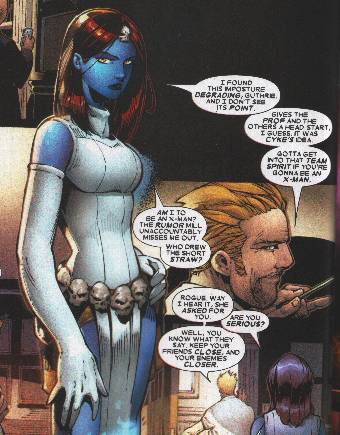
Kaja Silverman in her essay 'Fragments of a Fashionable Discourse' writes that clothing and dress is an important cultural implement for affixing sexual identity (1986:146), and Mystique’s clothes/costumes support this theory. As a representation of her sexuality, Mystique’s clothes change throughout her career identifying to the reader what to expect (or not) from her sexually. Her first costume in which she was seen from approximately 1977 to 1995, covers her breasts and upper torso tightly, while her groin is covered by a long flowing skirt that is side split to the waist that would hardly hide her genitalia in any situation, and emphasises her breasts as fetish objects.


Mystique as coloured nude
- X-Factor #127 (1996)
As a villain she holds the attributes of the phallic woman (not the least because she can transform into a male) represented by the fact that at any moment her skirt may reveal an actual phallus, which is no doubt an entertaining but horrifying possibility for her heroic foes (and fans). The skulls on her belt are also indicative of the possible horror lurking beneath. At this stage of her career we don't know where her sexual preferences lie. She is sexually ambiguous. Hinted at for many years but finally revealed in X-Men Forever #5 (2001, on the inside front cover), is that Mystique's constant companion, the precognitive mutant, Destiny (aka Irene Adler), is her lover. Therefore she threatens patriarchal culture in the X-Men titles not just as a phallic woman but also although not explicitly stated) as a lesbian.

As a member of the X-Factor team (X-Factor, 1995 to 2003), and therefore coded good, her clothes/costume changes from exhibiting threatening polyphallic qualities to a more feminised, appealing figure. Like many other female heroes, and like much superhero comic art, Mystique is drawn as a coloured nude, expressing a closed, smooth body, that is sexually appealing to males. She becomes, as Jean Baudrillard argues, a phallic effigy, a safe reflection of the masculine rather than an opposition. 
Mystique in leather 
costume-
Mystique #4 (2003)

When Mystique gets her own series (2003-05) her costume consists of a cropped black leather top, pants, gloves, and heavy black boots. Leather is associated with toughness and masculinity as well as erotic connotations suggestive of danger, seduction, and sado-masochism. As Sherrie Inness suggests, wearing masculine clothing is indicative of a woman’s ‘capacity for action and leadership’ (1999:25). Thus leather marks Mystique as active rather than the passivity associated with the feminine. Keeping these associations in mind, leather is implicitly linked to lesbianism, and as such indicate Mystique’s alignment with lesbianism. While she isn't associated with any female lovers (or male for that matter) in the Mystique series, Brian Vaughn (writer) makes quite clear her preference for females by a number of intertextual "queer" references. In Mystique #7, a man in an airport walks past an attractive woman, muttering, ‘Have mercy’ (Vaughn and Ryan, 2003:19). The man happens to be Mystique in a male form. In Mystique #19 she is presented with a pen once used by Oscar Wilde.


Mystique in costume 
similar to her original -
 X-Men #189 (2006)
Mystique keeps her leathered-up look throughout X-Men #172-187, her appearance in X-Men (August 2005) coming after the Mystique series was discontinued (April 2005). In this run of issues Mystique's queerness is still evident albeit twisted. I won't go into the logicalities (or illogicalities) of her strategy, but suffice to say that in X-Men #172 Mystique begins a series of episodes where she tries to seduce Rogue’s boyfriend, Gambit, in an effort to help Gambit and Rogue’s relationship. But she is clearly operating at odds with herself as she remarks to Gambit of having sex with him: ‘The idea repels me as much as it does you’ (Milligan et al, 2005:31). Her sexual preference then is still clearly for women.

In X-Men #189 (2006) she returns to a costume very similar to her original and - apart from a short regress to a costume reminiscent of her X-Factor outfit (with skulls removed) - has remained with it up to the present (October 2010). Though operating in the X-Men and Dark X-Men teams, she is once again clearly a villain. This period is characterised for Mystique by a storyline running through the X-Men titles (the 'Messiah Complex' crossover) involving Destiny and her diaries. Thus what is happening is that her sexuality is subsumed, being made covert as represented by choice of costume.

While there is a storyline where Mystique has a love/hate relationship with Iceman (X-Men and X-Men: Manifest Destiny, 2008-09)  Mystique's actions with Iceman are characterised by the following exchange - 
Iceman:'I let you get close to me once. Touch me. I wish to God I hadn't!' 
Mystique: 'So do I. It's hard to pretend that touch didn't happen. But I'm working on it.' (Carey and Ryan 2009a:5).
Dark X-Men #4 
(2010)
However Mystique's words are ambiguous. They can be attributed either to her not liking Iceman, or her not liking men in general. Of course, it could be both.

In X-Men: Manifest Destiny #5, after a terse exchange where Iceman rejects Mystique's misguided overtures (if they are that), Mystique says, 'You'll love me. I promise you that.' (Carey and Ryan 2009b:7). Again, what it actually means is anybody's guess. To the present there has been no indication of further interest in Iceman by Mystique.

In Dark X-Men #4 (2010) Mystique mentions Irene (Destiny) in trying to make sense of her situation involving Norman Osborn. These references and her costume signal a return to her ambiguous sexual nature - neither explicitly straight or gay. Mystique's relationship with Destiny has always been subtle and unlike characters such as Northstar who famously came out of the closet to reveal his gay sexuality, the same 'coming out' hasn't been afforded Mystique. Neither has she been explicitly positioned as bisexual. Is this a problem? Not necessarily. In fact Mystique's constant changes make her one of the most interesting comic characters in any comic universe. Whether she's gay, bisexual, or straight, doesn't particularly matter unless there's a problem with Mystique being portrayed as such. The question then is - why would that be? If she's bisexual or lesbian, why not make it clear?

For now it seems Mystique is once again an unknown sexual quantity.


Dark X-Men #3 
Cover (2010)
Reference


Carey, M. (w), Ryan, M. (p), and Olazaba, V. (i) (2009a) 'Kill or Cure, Part 4', in X-Men: Manifest Destiny #4 ( Lowe, N. Ed.)(Feb. 2009), New York: Marvel Publishing Inc.


Carey, M. (w), Ryan, M. (p), and Olazaba, V. (i) (2009b) 'Kill or Cure, Part 5',in X-Men: Manifest Destiny #5 ( Lowe, N. Ed.)(March. 2009), New York: Marvel Publishing Inc.


Inness, Sherrie. (1999) Tough Girls: Women Warriors and Wonder Women in Popular Culture, Philadelphia: University of Pennsylvania Press.


Milligan, P. (w), Larroca, S. (p), and Miki, D. & Martinez, A. (i) (2005a) ‘Bizarre Love Triangle: Temptation: Part 2 of 4',  X-Men v1 #172 (Aug. 2005), New York: Marvel Comics.

Silverman, Kaja. (1986) ‘Fragments of a Fashionable Discourse’, in Modleski, T. (ed.) Studies in Entertainment: Critical Approaches to Mass Culture, Bloomington: Indiana University Press.


Vaughn, B. (w), and Ryan, M. (p)(2003)‘Tinker, Tailor, Mutant, Spy, Chapter One of Four’, Mystique v1 #7(Dec. 2003),New York: Marvel Comics.

The BookDepository

Thursday, August 26, 2010

Part 2 - Something Quite Close to Hell: The Monstrous Female in Darkchylde

Part 2 of 'Something Quite Close to Hell: The Monstrous Female in Darkchylde' investigates representations of the archaic mother and pre-oedipal in Darkchylde.


Having argued as to why Ariel has become monstrous, now I would like to turn to what purpose she serves by taking up the position of ‘the monstrous feminine’. Ariel in her human form is the ‘acceptable’ form and shape of woman. When she transforms into a demon from the nightmare realm she becomes monstrous. Therefore the ‘pleasurable’ and ‘acceptable’ Ariel is needed to offset the visually horrifying aspects of her monstrousness. As a representation of the ‘monstrous-feminine’, Ariel exhibits characteristics that can be aligned with the feminine archetype of the archaic mother.

At this point it must be stated that there is some confusion over the figures of the pre-Oedipal and archaic mothers. Elizabeth Grosz in Feminism and Psychoanalysis: A Critical Dictionary (1992) and Mike Davis in his essay "'What’s the Story Mother?’: Abjection and Anti-feminism in Alien and Aliens" (1995) both refer to the pre-Oedipal mother as analogous to the phallic and archaic mothers. Barbara Creed however makes a distinction between these figures. She states that the pre-Oedipal mother is the mother of infancy, who is responsible for the early socialization of the child, while the archaic mother is the generative, parthenogenetic mother who gives birth to all living things and exists in all human cultures as the Mother-Goddess (Creed 24). Creed’s theorisation, I believe, is more useful as the pre-Oedipal mother, although a genderless ‘fantasy’ (the imaginary ‘paradise’ of the mother-child dyad), has a corporeal nature in the form of a person, whereas the archaic mother is a concept whose figure permeates the imagery of birth, primal scenes and the womb (Creed 19). The figure of the archaic mother is explored through the monsters into which Ariel transforms. When Ariel transforms she becomes a fetish object of the archaic mother carrying out the archaic mother’s wishes of reincorporating all to which she has given birth to through death and destruction.

The archaic mother is the parthenogenetic mother, the mother as primordial abyss, the point of origin and of end. She is the generative mother; the pre-phallic mother who exists prior to knowledge of the phallus (Creed 17-20). More importantly, the concept of the archaic mother does not depend on a concept of the masculine against which to define itself (Creed 27-8). This is because she exists before gender differentiation and does not need a masculine counterpart to exist. As the archaic mother exists only as a concept, Creed argues that the re-incorporating and destructive powers of the archaic mother are concretised in the figure of her offspring, the creature(s) whose mission is to tear apart and reincorporate all life (22). These offspring are represented in Darkchylde as the monsters into which Ariel transforms. These monsters are fetish objects of the archaic mother.

Freud defines the fetish as ‘a substitute for the woman’s (the mother’s) penis that the little boy once believed in and… does not want to give up’ (Freud 1961, Vol. XXIII, 152-3). According to Freud’s narrative, this takes place when the little boy sees, or simply realises, his mother or another close female figure, has no penis. He assumes that she has been castrated. He will deny this castration by replacing the penis his mother should have with the closest or first thing that he sees at the moment of realisation so as to deny that he can also be castrated. I use ‘he’ in this explanation because this is generally how the fetish is formed in the male child. Fetishism for the female child is quite different.

When the female child realises that her mother is castrated, she (eventually) recognises that she is also castrated. Comprehending that she can never have a penis of her own, and recognising that she cannot ‘own’ her father’s, she succumbs to the idea that her destiny is to have a child (preferably by her own father) as a replacement for the penis. Therefore a baby is what is deemed as her fetish object, her replacement penis. Hence the offspring of the archaic mother are referred to as fetish objects. But the offspring of the archaic mother are special because the archaic mother has no male counterpart, and therefore procreates without the aid of a male.

In the final battle of Darkchylde, Ariel transforms into a dragon where she kills the villain Kauldron and a host of other demons emerging from the nightmare realm. During this rampage Ariel also kills Perry’s father, Jack. Perry is Ariel’s love interest and he employs his father to help Ariel escape the authorities of the government agency SENTRY, for whom Jack works.

The death of Jack is seen to be an accident. However if we see Ariel in relation to the archaic mother, the situation can be better explained. Jack is in a position of authority at Sentry, a government agency interested in paranormal phenomena, and is also a father (reminding Ariel of her own father). Both aspects position him as a representative of the Law of the symbolic order. Killing Jack institutes a two-fold elimination of male dominance and power, first, by directly eliminating his paternal power. Second, with his father dead, Perry recognises the danger that Ariel poses to himself and sends her away, which eliminates him as a future representative of the Law. Ariel’s rampage of annihilation ensures that Ariel can never take up a position in the symbolic order, and as fetish object of the archaic mother, she doesn’t want to, which is in direct opposition to her ‘human’ desire to ‘fit in’. As a fetish object of the archaic mother, Ariel becomes a weapon which eliminates male, phallic dominance by reincorporating through destruction and death everything to which she has given birth.

Like the archaic mother, Ariel is constructed in opposition to, not separate from, the symbolic order. She is relegated to the margins to ensure the constitution of subjectivity and the law (Creed 26). Ariel states during the final battle of the comic:
I’ve invited all this rage that’s racing through me like a dark cancer, eating away at anything that remains of Ariel Chylde, and leaving in its place only the monster…and I feel my very essence threatened to be irreversibly consumed by the dragon…I almost welcome it… (Queen 129).
The invited rage that threatens Ariel’s essence is a veiled desire for oneness. This is best explained when Barbara Creed argues:
The desire to return to the original oneness of things, to return to the mother/womb, is primarily a desire for non-differentiation. If as George Bataille argues in Death and Sensuality, life signifies discontinuity and separateness, and death signifies continuity and non-differentiation, then the desire for and attraction of death suggests also a desire to return to the state of original oneness with the mother. As this desire to merge occurs after differentiation that is after the subject has developed as separate, autonomous self, it is experienced as a form of psychic death (28).
Consummation by the dragon, for Ariel, translates into a loss of self or ego, a ‘psychic death’ that is a desire for continuity and the loss of boundaries (Creed 30) where her desire to be one with the archaic mother would be realised. However Ariel is not allowed to ‘lose herself’, for to return to a oneness with the archaic mother would be to transgress the rigid ego boundaries of self and other which define phallocentric culture and patriarchal law. Instead Sage, the representation of Ariel’s pre-Oedipal mother, who as I have argued, exists in relation to the family and the symbolic order and is responsible for the socialisation of the child, scolds Ariel: ‘Ariel, no! You must relinquish this form at once or it will destroy you! And without your influence it will destroy us all!!’ (Queen 129). The tone of this quote is what distinguishes it as a socialising mother’s voice. She is not asking Ariel to relinquish her monstrous form, she is telling her – ‘you must relinquish this form at once…!’

Ariel has two desires. In her monstrous form as fetish object of the archaic mother she desires to return to a oneness with the archaic mother, not the body of the pre-Oedipal mother, because the monstrous form that Ariel occupies is a result of her unbroken link with the pre-Oedipal mother. When Ariel is in her human form she yearns for a return to the Imaginary where she recognises nothing other than herself and the body of her mother: ‘…lost in the amber glow of your eyes as you cradled me… I wish I could feel the gentle thrum of your heart as you held me to your warm breast’ (Queen 98).

What comes to pass is a power struggle between the archaic mother and the pre-Oedipal mother for control of Ariel. The archaic mother wants to overthrow the symbolic order, and as a fetish object of the archaic mother, Ariel will carry out her wishes of reabsorbing what she once birthed through a rampage of destruction. The pre-Oedipal mother, on the other hand, wants to uphold the Law of the symbolic order. Ariel is thus in a bind–to return to a oneness with the archaic mother where the psychic death of the self represents continuity and non-differentiation, or adhere to her pre-Oedipal mother and try to ‘fit in’ to a symbolic order that rejects her, and live a life that signifies a constant and seemingly endless time of discontinuity, marginalisation, separateness and lack.

While Ariel does return to her human form signifying the pre-Oedipal mother’s stronger hold, nothing is resolved. Ariel has killed and destroyed ensuring her no place in the symbolic order. Perry tells her ‘They’re going to hold you accountable. They’ll kill you Ariel…You’ve got to get out of here. Leave Salem forever!’, and that she has to ‘…find somewhere.’ (Queen 133).

It is telling that Ariel’s first metamorphosis into a monster occurs when she kills her father. Through her metamorphosis, Ariel decentres and reproduces herself. Decentralisation is the process of breaking away from the Western cultural habit of referring all experience to centres, beginnings, or origins of truth and being (Bersani 196). Bersani states it is in ‘parents and in brothers and sisters, the child finds himself by finding himself repeated’ (202) and it is only by smashing self reflections that one can decentralize themselves (216). Ariel kills her father in a pure and final act of anger and self preservation, destroying his paternal hold and power over her. In her father Ariel sees a repetition of herself, a centre, an origin. Killing her father is also an effort to break the cycle of abuse and the constant re-locations to different towns and schools. While moving from town to town finds Ariel always somewhere new, always ‘somewhere else’, it is really only a change of setting with the same script. Ariel’s decentralisation and transformation into monstrousness is different. It allows her to be ‘somewhere else’ within herself, signifying that she is not the origin or centre of what is happening to her, that she is not a killer, nor is she associated with her repetitive life, or her father. Put simply, she becomes an outsider looking in on herself.

The villain Kauldron is also a repetition and doubling of her father, of patriarchal law. In finally killing Kauldron, Ariel eliminates another repetition of her father and therefore herself (remembering in family members we find ourselves repeated). Each kill allows further decentralisation to that outside position but from which she must always return. This cycle is the attempt to eradicate the imprinted identity of the Law, something that must be done over and over. Ariel is thus caught in a cycle of endless repetition, from which she continually strives for release. This cycle involves men in positions of power trying to use or hurt her, who are, like Kauldron, repetitions of her father, and herself, who she will have to kill over and over again in an endless attempt to completely decentre herself, to be ‘somewhere else’.

Without going into the complexity of death and repetition too deeply, we can say that Ariel’s repetitive compulsion is a desire to restore an earlier state of things (Freud 1961 Vol. XVIII 36). Ellie Ragland argues, that this earlier state of things is the earliest state–that of being one, in the Imaginary, with the mother. She writes:
although the goal of repetition is to re-experience a prior […] satisfaction, the effort to recapture such lost moments depends on the fixations put in place to compensate for the loss of the primary object: that is, the illusion of a primordial oneness between child and mother (Ragland 89).
Ariel’s repetitive compulsion does three distinct things. First, her killing of patriarchal male figures becomes an attempt to eradicate the ‘Law-of-the-Father’ (and its imprinted identity) that intrudes upon the mother-child dyad. Second, Ariel also kills repetitions of herself when she kills these males, in the attempt to decentre herself. This action, we can also say, is an effort to be one with the mother, a return to the blissful state of the Imaginary.

Ariel’s initial loss of her mother becomes a ‘palpable void’ (Ragland 87) and it is this loss that drives her life. Her murderous actions against patriarchal male figures become Lacan’s object a, that which is used to try and fill this void. Ragland’s argument can again be applied to Ariel as she is:
repeating relations to objects whose crucial function of semblance is that of filling up an actual void. Thus human beings pursue objects that sustain fantasies, even though attaining an object of fantasy can never completely close the void (Ragland 87).
Ariel’s fantasy is that she will one day ‘fit in’ and this is most readily achievable in the Imaginary where she could never be an outsider, but again Ariel’s (unavoidable) actions only push this fantasy further away.

Ariel’s repetitive gothic storyline positions her as both sadist (one who inflicts pain on others) and masochist (one who inflicts pain on themselves), both dominated and dominator, at once submissive and assertive (Day 19). In short, a masochistic/sadistic catch-22. Her efforts to eliminate the repetition of herself that she sees in others leads only to situations that will induce her to kill more repetitions of herself in an endless cycle. Her life is the archetypal “damned if you do, damned if you don’t”. Wherever Ariel goes she can never be free from patriarchal Law which she threatens, and which will always threaten her. Ariel remains, both inside and outside male society; romantically idealised and a victimised outcast (Eagleton 190) literally always relegated to ‘somewhere else’, decentralised, never able to just ‘fit in’.


References

Bersani, Leo. A Future for Astyanax. Columbia University Press, 1984.

Creed, Barbara. The Monstrous Feminine: Film, Feminism, and Psychoanalysis. London and New York: Routledge, 1993.

Davis, Mike. “What’s the Story Mother?: Abjection and Anti-Feminism in Alien and Aliens.” 1995 http://www.ac.uk/fac/arts/English/wip/dav3ii.html(Please Note: this link is no longer active. The essay can be found here in Gothic Studies 2 (2000): 245-56.)

Day, William Patrick. In the Circles of Fear and Desire. Chicago: University of Chicago Press, 1985.

Eagleton, Terry. Literary Theory: An Introduction. Oxford: Blackwell, 1983.

Freud, Sigmund. The Standard Edition of the Complete Psychological Works of Sigmund Freud. Vols. Vol. XXIII (1937-39). London: The Hogarth Press., 1961.


Queen, Randy. Darkchylde: The Descent. La Jolla: Wildstorm Productions (DC Comics), 1999.

Friday, June 25, 2010

Notice the Difference? Eliminating the Feminine in Superhero Comics

In the coming posts I will be going retro and presenting pieces on comics produced in the 1990s, specifically the comics Wetworks, Darkchylde, and Witchblade,

In this three part essay I discuss how the feminine is effectively eliminated in superhero comics by eradicating the difference between the sexes reducing them to an economy of the same.

Part 1 compares standard human anatomy with bodies in superhero comics showing how female characters are depicted with characteristics of the ‘standard’ male body. Male bodies are subsequently rendered as hypermasculine. Using the work of Jean Baudrillard I show how the female superhero body is phallicised thus creating ‘erectile’ parts.

Part 2 uses Baudrillardian theory to analyse the superhero comic Wetworks demonstrating how the phallicised female body is eliminated when it is used as a mirror that reflects male dominance and desire. The female is further not allowed to become a body due to her potential threat of castration (the vagina dentata and the phallic woman) which is eliminated when she is eliminated as female.

Part 3 covers how armouring the male superhero body is an attempt to elicit self-control and thereby control the feminine that is embodied in chaotic, uncontrollable and changing ‘outside forces’. I further establish how armouring the body is unworkable due to its passive mode of resistance. I describe the next step in the process to control outside forces as becoming the weapon/machine and the consequences that this can have for culture at large.


Notice the Difference? Eliminating the Feminine in Superhero Comics
(Part 1)

Of course the female form has absurdly exaggerated sexual characteristics; of course the costumes are skimpier than one could (or should) imagine; of course there’s no visible way that these costumes could stay in place; of course these women represent simple adolescent masturbatory fantasies (with a healthy taste of the dominatrix) (Bukatman 112).

The female superhero body is constructed as hyperfeminine, as a spectacle insistent on breasts, thighs, crotch, and hair. In the quote above Scott Bukatman answers why female superheroes are drawn the way they are – they’re eye candy to satisfy the male gaze. You might also answer that because the vast majority of superhero comic artists are male, they draw female superheroes that way because they can. But what is it about these female superhero bodies that make them so good to look at so that, of course, they must be drawn with absurdly exaggerated sexual characteristics? Why are their costumes skimpier than one ‘should’ imagine? There must be more to it, and there is.

In part one of this essay I’ll undertake an anatomical comparison of ‘real’ female bodies against bodies represented in superhero comics. This line of reasoning will explicate how the female superhero body is depicted according to characteristics normally associated with the male body. The male body, in turn, has been exaggerated to hypermasculine proportions. I’ll argue that superhero comics reduce all ‘others’ to the economy of the same by eradicating the difference between the sexes (Irigaray 74). I’ll use the work of the French theorist Jean Baudrillard to demonstrate how the male and female superhero bodies and body parts are phallicised as ‘erectile parts’.

In her book An Introduction to Drawing the Nude Diana Constance recognises that the standard female torso is longer than a male’s, the distance from her waist to crotch is also longer, and her hips are wider than her shoulders – ‘no amount of dieting will ever give her the slim hips of a man’ (Constance 23-4). The ‘standard’ body of a male has longer legs than a woman and his shoulders are slightly wider than his hips (Constance 23). Comparing the ‘standard’ body of a human to that of a comic book character might seem silly or even absurd but there is nothing to say that characters shouldn’t, at least proportionally, exhibit the characteristics of a ‘standard’ body. However, in superhero comics there is a radical inversion of the female’s standard body characteristics where the female superhero body exhibits characteristics of the standard male body. Their shoulders are wider than their hips and their legs are longer than a males (sometimes alarmingly so). Because of this fusion of the female into the male form, the distinctive sexual characteristic of the female – her breasts – are made prominent to distinguish the character’s “femininity”. This in turn makes the breasts appear unrealistic, ‘stuck’ on, and disharmonious with the rest of the body. The effect this has on the depiction of the male superhero body is that male features need to be exaggerated to a hypermasculinity. The male’s shoulders and legs are made wider (by muscles or armour/costume), and the torso becomes overtly muscled and lengthened.


There is further evidence to suggest that female and male superhero bodies are ascribe to the one ideal. The ‘standard’ female body requires the pubic area to be just below the mid-point of the body (Constance 23). Moving the pubic area above a females’ natural mid-point, lengthens the legs and shortens the torso thereby eliminating the hips (a defining female body feature), leaving the legs to butt straight on to the waist. With the torso shortened the female gains another ‘standard’ male body feature. This elimination of the female characteristics is demonstrated in the WILDC.A.T.S advertisement (Figures 1 and 2) where the male and the female characters, Ripclaw and Zealot, have virtually the same body (high heels and hair too)! (See further images in the Image Appendix). The elimination of the female body, I believe, has to do with the fetishisation/phallicisation of the female form. The work of theorist Jean Baudrillard provides a useful framework for understanding this phenomenon.

Superman’s value as the first ‘super’ hero was of a symbolic nature. All the drive he needed was the inherent goodness in doing the job. No rewards necessary or wanted. The ‘S’ on his chest is his sign; his symbol of recognition. Without the ‘S’ he’s just a big guy in a blue suit. The costumes of more contemporary superheroes are conspicuously devoid of individual signs, (characters from the Image titles of the early 1990s are a case in point). They are just big guys in colourful suits. Far from being superheroes for the sake of it, many are employed by an individual, corporation, or governmental department, consequently embedding them in the political economy of the sign. By accepting money for their heroic actions they become rationalised subjects, turning them into items of exchange value – the abstract, meaningless value of quantity measured in monetary terms. A superhero’s exchange value can subsequently only be measured against that of other superheroes.

Without individual signs that designate identity (or only ones that align them with a certain group or corporation) the superhero is now merely a sign that reproduces the capitalistic economy. Now to designate a superhero’s individuality the superhero’s body becomes a sign – the guy in this suit is bigger and different that the guy in that colourful suit. However, Baudrillard states that signs covering the body reduce it to uniformity or an ideal type. Signs cover, divide and annihilate the body’s difference in order to organise it into structural material for sign-exchange (101). Thus the superhero’s body can also be reduced to an ideal type. This ideal is derived from one source – a body and an economy derived from ‘a sexuality taken as a determining agency, a phallic agency entirely organised around the fetishisation of the phallus as the general equivalent’ (Baudrillard 101). The hypermasculine male ideal of which the superhero stands as an emblem is designed around this phallic general equivalent. As Scott Bukatman argues –

Indeed, with their thick necks, bulging veins, and protruding tendons tightly swathed in coloured skintight hoods, these heroes really become enormous dicks sheathed in an array of distinctly baroque (and somewhat painful looking) condoms – an effect both menacing and comical (111).

In Baudrillard’s terms – ‘the entire body has become a phallic effigy’(102). For Baudrillard the body has moved into representation, it is a sign that is constructed via a structuralist mode consisting of the phallic effigy/fragment of the body/subject as signifier, and sexuality as signified. The body is not an erogenous zone anymore, but an eroticised zone in a capitalist economy of exchange value. It is a site that does not produce excitement but is produced to excite.

We must remember that for the most part superheroes – ‘Despite accoutrements such as logos, masks, gauntlets, epaulets and other superhero accessories… are essentially presented as nudes (costumes are more coloration than cover up)’ (Bukatman 106). This colouration/costuming of superhero nudity produces ‘Certain marks… (that) render the body more nude than if it were really nude… these marks may be clothes or accessories’ (Baudrillard 121n). Accessories such as ‘the tight fitting bracelet round the arm or the ankle, the belt, the necklace and the ring’ are staple parts of superhero attire which for Baudrillard ‘establish the foot, the waist, the neck or the finger as erectile parts’ (102). While both male and female superheroes sport these accessories, the female superhero body, with exaggerated legs and breasts, is the most prominent in this process of phallusisation. While we have already seen that male superheroes are bulging ‘dicks’. However it is not only certain bodies or body parts that can be transformed into phallic effigies. In fact –
Any body or part of the body can operate functionally in the same way, provided that it is subject to the same erotic discipline: it is necessary and sufficient that it be as closed and as smooth as possible, faultless, without orifice and “lacking” nothing, every erogenous difference being conjured up by the structural bar that will design(ate) this body (in the doubles sense of “designate” and “design”), visible in clothing, jewellery or make-up, invisible but always present in complete nudity, since it then envelops the body like a second skin (Baudrillard 104-5).
Baudrillard is arguing that anything that marks the body as ‘closed and smooth as possible’ (including make-up, lipstick, tattooing, scarring) can be placed in the structural demarcation of phallic effigy as signifier, alongside male sexuality, or phallic agency, the general equivalent everything is defined against. In other words the phallus is the standard marker or measure of identity.

Reference

Baudrillard, Jean. Symbolic Exchange and Death. London: Sage, 1993.

Bukatman, Scott. “X-Bodies (the torment of the mutant superhero).” Uncontrollable Bodies: Testimonies of Identity and Culture. Ed. Rodney Sappington and Tyler Stallings. Seattle: Bay Press, 1994.

Constance, Diana. An Introduction to Drawing the Nude. London: New Burlington Books, 1993.

Irigaray, Luce. This Sex Which Is Not One. Ithaca, New York: Cornell University Press, 1985.